An invoice says: pay 12.50, in Australian dollars. The customer sends 12.50, in US dollars.
The number matches. The money doesn't. A careful shop doesn't mark that invoice paid. It notes what arrived and waits for the right money.
Part one of Deed #5 built a checkout that takes a stablecoin on Solana and reads the chain to see whether it was paid. It ended on what wasn't built: "A second currency and webhooks, where a provider pushes a notification so the server doesn't have to keep asking, were the stretch goal."
Both are built now. Ten minutes after the second one was merged, it failed its own check.
Watch the part-two demo on YouTube.
What happens when the number is right and the money is wrong?
The checkout now prices an order in one of two currencies. USDC tracks the US dollar. AUDD tracks the Australian dollar.
The rule is the invoice's rule. An order is priced in one currency and only that currency pays it. Nothing is converted, and there is no exchange rate anywhere in the code.
On devnet, an order for 7.50 AUDD was sent 7.50 of the other token. The checkout rejected it with this reason:
paid in USDC, but this order is priced in AUDD: 7.50 USDC reached the merchant and is not counted for this order
Then 7.50 AUDD arrived and the order was paid.
One choice here was mine. In part one, money from a rejected underpayment goes on a list of amounts owed back. Wrong-currency money doesn't. It reached the shop and the order's log says how much, but I chose that over stretching the refund record to hold a second token. Returning it is manual.
Why is the AUDD a stand-in?
The issuer's AUDD exists on Solana's main network. It doesn't exist on devnet, the test network, and this build refuses mainnet. We checked both on the chain: the mint is there on mainnet, a classic SPL token with 6 decimals, and the same address is empty on devnet.
So the AUDD in every test here is a test token made for the purpose, with the same 6 decimals. The order page says so under the amount box. Nothing was tried with the real token.
Why AUDD, if the token is made up?
Because a stablecoin doesn't have to be a US dollar.
The real AUDD is issued in Australia by AUDC Pty Ltd under an Australian financial services licence, AFSL 700123, and can be redeemed 1:1 for Australian dollars. That is from the issuer's own site, read on 23 November 2026.
For us there are two big reasons to want a local one. If you earn and spend in Australian dollars but hold US dollar coins, the exchange rate moves under you. And every conversion is one more thing to account for at tax time. A price in your own currency avoids both, which is why this checkout never converts.
One thing to check before building with any local stablecoin for real: each country's regulator sets the rules for how one is issued and used. Read those first.
A disclosure: we hold a grant from AUDD's issuer.
How does a shop stop asking every second and a half?
Part one's server asked the chain every second and a half: any transactions with this reference yet? That works. Nearly every one of those questions gets the answer no.
Your bank already has an answer to that. It sends you a text: payment received.
You know the catch. Anyone can send a text that claims to be your bank. So you never act on the text. It only tells you when to look. You open your own statement and check. And if no text comes, you still look now and then.
On Solana the text is called a webhook. A provider watches the shop's token account on the chain. When a transaction touches it, the provider calls the shop's server and names the transaction.
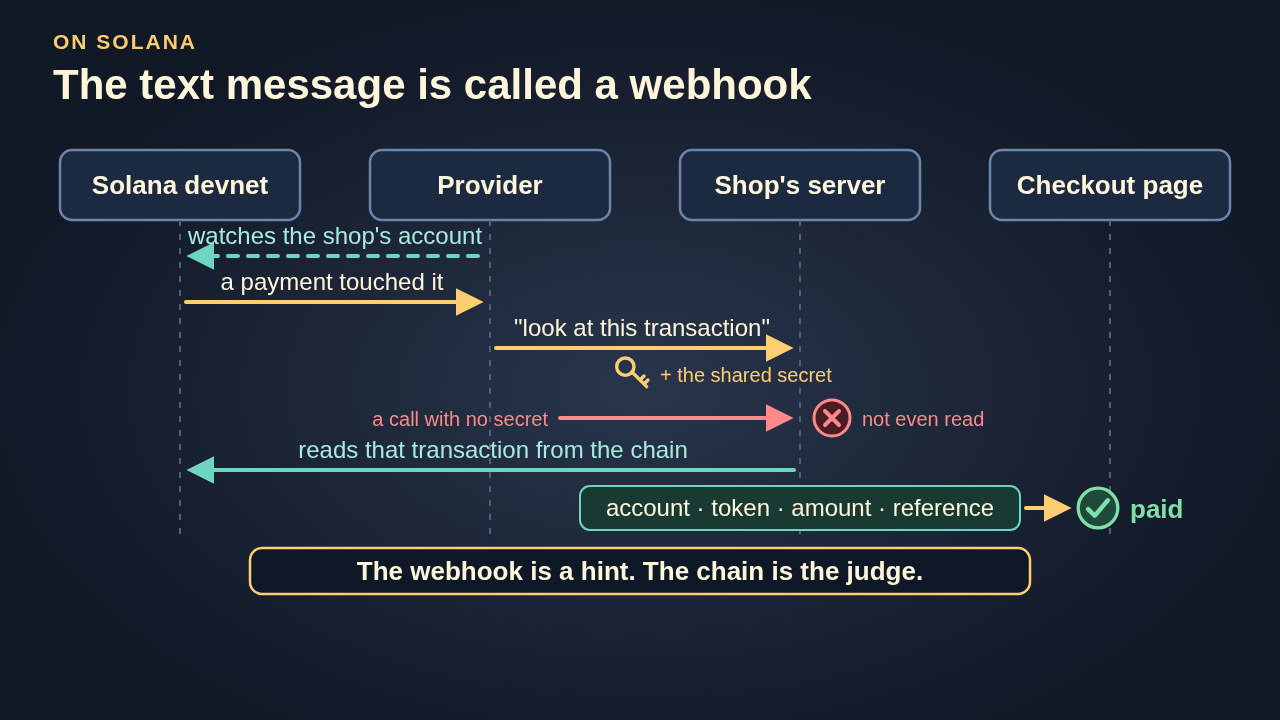
The call has to carry a secret only the two of them know. Without it the server doesn't read the message. With it, the server does what it did before: it reads that transaction from the chain and checks the account, the token, the amount and the reference.
The webhook is a hint. The chain is still the judge. That is why a shared password is enough here: a forged, late or repeated message can't mark anything paid. The most it can do is make the server look.
The server still checks the chain on its own, every 15 seconds by default. A lost text makes the shop slower to notice. It doesn't make it miss a payment.
Who sends the text?
Every app talks to Solana through an RPC endpoint. You ask it a question or hand it a transaction, and it passes that to the network.
Solana runs free public endpoints. They are shared by everyone and rate-limited; while this was being built, the test script was turned away with HTTP 429 more than once. And a public endpoint only answers. It never calls you.
An RPC provider sells its own access to the chain and adds services on top. Helius is one, and one of its services is the webhook: it watches an account and calls your server. We used Helius because it's a reputable provider. It isn't the only one: Alchemy, QuickNode, Triton One and Chainstack each offer Solana RPC too, by their own pages on 23 November 2026. Which you pick is the builder's call.
In this build the checkout still reads the chain through the public endpoint. Helius only sends the hint.
Did a real provider actually call?
Once, for two payments.
I had a Helius key and said it could be used. Claude told me the cost first: by Helius's published prices, 100 credits to create a webhook, 100 to delete it and 1 for each delivery. The whole test came to 202.
For the test, Claude set the server's own check of the chain to once every two minutes. If an order turned to paid within seconds, only the webhook could have found it.
I paid a 20.00 AUDD order from my phone. The payment's block time was 11:30:09 UTC. The server marked it paid at 11:30:11, and the last line of the receipt read "Found by: a webhook call". It's on Solana's explorer. A scripted 1.00 payment a few minutes earlier went the same way, also in about two seconds.
Then I scanned a 75.00 order with 30.00 left in the wallet. The server refused before anything was signed: "this wallet holds 30.00 AUDD on devnet and the order is 75.00 AUDD: 45.00 AUDD is missing".
That is one provider, one delivery shape and two deliveries. The refused call, the repeated call and the lost call were tested with a script that plays the provider, not seen from Helius.
What broke after it was merged?
The webhook check gave up too easily, and the saved evidence didn't show it.
A provider can call the moment a transaction lands, before the server's own connection to the chain shows it. So the server looks up to five times, a little further apart each time.
The fault: an error on any one of those looks ended the whole check. Public devnet rate-limits. One refused request, and the server stopped looking until its slow check came round.
Nothing was marked paid that shouldn't have been. The slow check, built for a lost webhook, covered this as well. But the fast path was less reliable than our evidence said.
It was found by a routine step. Before the public source is updated, the playbook says to clone it fresh and run the one-command reproduction from that clone. Claude did, ten minutes after the merge and three after the issue was closed. The webhook step failed: the call was accepted, and the order was marked paid 44.9 seconds later by the slow check. The source was not published.
Here is the miss. The day before, that same script had failed three times on devnet's rate limits, and Claude had taught the script to wait and retry. Nobody asked what the server does when its own requests are refused the same way.
One thing is inferred. A test now shows that one error ended the check: with the first answer forced to an error, the server made one request and stopped. That an error is what happened in the failed run is a deduction from how fast the server answered. The script had thrown the server's log away, so the error itself was never seen. The script keeps that log now.
The fix was small: a failed look is logged and the next look still happens. Two tests failed before it and pass after. Asked, I had it merged the same day, and the public source was rebuilt from that commit and published.
What did the review before the merge catch?
Claude reviews its own work before a pull request, and nobody else reviewed this one. Two things came out of that.
The evidence page listed each scenario beside the test that covers it. Checked line by line against the tests, four rows said something different from what their tests assert. All four were reworded.
Behind one of them was a real gap. The check on a configured token looked only at its decimals. A token from Solana's newer token program with 6 decimals would have been offered as a currency and then been impossible to pay, because the transfers this checkout builds can't move it. The check now looks at which program owns the token as well.
What's still open
The AUDD is a stand-in. One webhook provider was tried, with two real deliveries. The secret is a shared password, not a signature. Wrong-currency money is logged, not tallied. Orders still live in the server's memory. It still runs on my laptop, and the provider and my phone reached it through a temporary tunnel.
Nobody but Claude has reviewed the code.
You can check the rest with one command and a devnet keypair holding about 0.05 SOL. pnpm devnet:reproduce makes two test tokens and throwaway wallets, runs the wrong-currency case, then plays the webhook provider itself: a call without the secret, a call with it, the same call again, and an order that gets no call at all. The last run passed every check in 73 seconds and spent 9,665,800 lamports: rent deposits for seven new accounts, plus 90,000 in fees for nine transactions with two signatures each.
The source is public, now as a second snapshot. It has 69 tests; part one had 38.